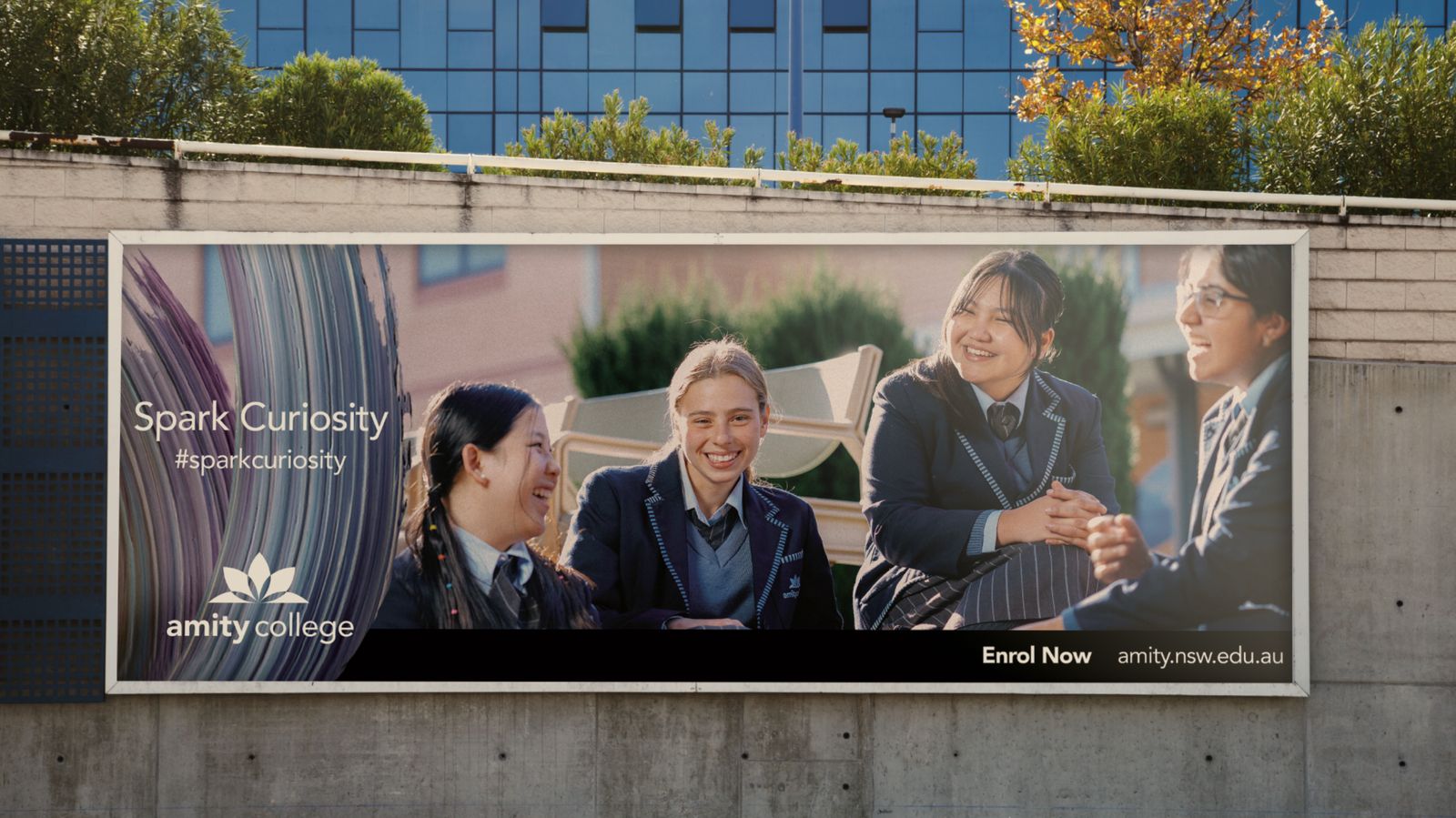
Most school marketing looks the same. A drone shot of the campus. Students walking down a corridor, laughing at nothing. A principal talking to camera about values.
Parents have seen it, and it doesn't move them, because every school is saying it.
The result, up front
Amity College's registrations maxed out across Years 7 to 10, and the school's organic following grew by more than 65,000. The campaign was built on students doing real things rather than on facilities, and it was cut for social feeds rather than for a single homepage film.
The situation
Amity cultivates students who are academically successful and who want to do something with it. That's a genuine difference, and it wasn't showing up anywhere in the school's marketing.
The enrolment problem sat downstream of that. When a parent can't tell your school apart from the three others they're touring, the decision falls to fees and travel time.
What we did
We stopped selling the school and started showing the students.
The campaign was built around real students doing real things, not staged, not scripted to a marketing brief. Where a school video usually cuts to the principal, ours stayed on the kids. Where it usually reaches for the facilities, ours reached for what a student was actually working on.
Then we cut it for where parents already are. Not one hero film sitting on a website nobody visits twice, but a run of short pieces built for the feed, each able to stand alone.
Why the follower number matters more than it looks
Registrations filling is the headline. The 65,000 is the asset.
A school with an audience that size isn't starting from zero each enrolment season. It has somewhere to speak to next year's parents, and the year after. Advertising buys attention for one intake; an audience compounds across them.
That distinction is the single biggest strategic difference between schools that stop worrying about enrolments and schools that run the same panic annually.
Three things to take from it
Enrolment marketing is a content problem before it's an advertising problem. Budget accordingly.
Specific beats polished. The footage that worked hardest wasn't the most beautifully shot. It was the most obviously true.
Build for the feed, not the foyer. One film is one impression. A campaign that yields thirty pieces is thirty chances to be the school a parent remembers.
Frequently asked questions
What made this campaign different from standard school marketing? It filmed students rather than facilities, and it was planned as a run of short social pieces instead of a single hero film.
How long did the campaign run? Enrolment campaigns work across the parent decision window rather than a fixed burst. Our full method is in how to run a school enrolment campaign.
Does this work for smaller schools? The approach scales down more easily than it scales up, because it depends on access to real student moments rather than production budget.
What should a school measure? Enquiries, tour bookings and applications, not views.
See the project: Amity College. We run enrolment and brand campaigns for independent and community schools in Sydney. Get in touch.
Written by Omar Aziz, Grid Agency. Last updated 10 September 2026.